Introduction
Sustainability and ESG reporting are core expectations for businesses in the modern landscape, providing stakeholders and the public with important details concerning impacts and mitigation efforts. The Global Reporting Initiative (GRI) provides a comprehensive framework for sustainability reporting with standards covering an extensive range of topics. Here’s what you should know about GRI reporting and how you can implement it for your organization.
What Is the Global Reporting Initiative?
The Global Reporting Initiative provides the most widely used framework for sustainability reporting around the world. It establishes detailed standards that help organizations disclose their economic, environmental, and social impacts in a way that is understandable, comparable, and credible.
The GRI standards aim to improve transparency and accountability. They provide the framework for organizations to demonstrate their sustainability efforts and ongoing improvement to meet expectations from investors, regulators, and the public. Aligning with GRI standards lets companies build trust and shows their commitment to corporate social responsibility.
The Structure of the GRI Framework
The core of the GRI framework includes three universal standards. GRI 1: Foundation lays out the purpose, key concepts, and architecture of the GRI standards. It provides the starting point for organizations looking to use the framework for their sustainability disclosures. GRI 2: General Disclosures covers a variety of topics concerning reporting practices and activities that apply to organizations in general. GRI 3: Material Topics goes into further detail on reporting information concerning specific impacts on the economy, environment, and people.
The universal standards are complemented by additional resources that provide more specific guidance. Sector standards focus on specific sectors such as oil and gas, agriculture, and mining, and provide disclosures relevant to those industries. Topic standards offer detailed requirements for reporting on specific areas from effluents to carbon footprint, including standards like:
- GRI 301: Materials
- GRI 302: Energy
- GRI 303: Water and Effluents
- GRI 304: Biodiversity
- GRI 305: Emissions
There are more than 30 topic standards overall, addressing an extensive range of economic, environmental, and social topics.
Important GRI Concepts
There are several foundational concepts that organizations should understand in order to properly report under the GRI framework. These play an important role in standardizing reporting across different sectors and ensuring that disclosures remain focused and effective.
Impacts
GRI reporting focuses largely on impacts, the positive or negative effects an organization has on the economy, environment, and people. These can be actual or potential impacts and can include both short-term and long-term effects. GRI emphasizes understanding impacts not just within an organization’s operations but across its broader value chain and business relationships.
Materiality
Material topics are the subjects that reflect an organization’s most significant impacts. Organizations must evaluate the materiality of various areas, determining their relevancy, the extent of potential impact, and the influence that the organization has over them. It’s important to consider all potential impacts when assessing materiality, not just those deemed important by company ownership.
Due Diligence
Due diligence is a core aspect of GRI, defined as the process by which an organization identifies, prevents, mitigates, and accounts for its actual and potential impacts. It is an ongoing process that entails cooperation with a wide range of stakeholders to ensure responsible business conduct concerning impacts.
Reporting in Accordance With GRI Standards
Reporting in accordance with these standards requires organizations to meet all nine requirements laid out in GRI 1: Foundation. These criteria aim to ensure that sustainability reports are consistent, transparent, and focused on the most significant impacts.
The criteria to be considered in accordance with GRI standards are applicable regardless of an organization’s size, sector, or location. Failure to meet any of these essential requirements means that an organization cannot claim to report in accordance with GRI standards, but could still be able to say that they report with reference to the standards.
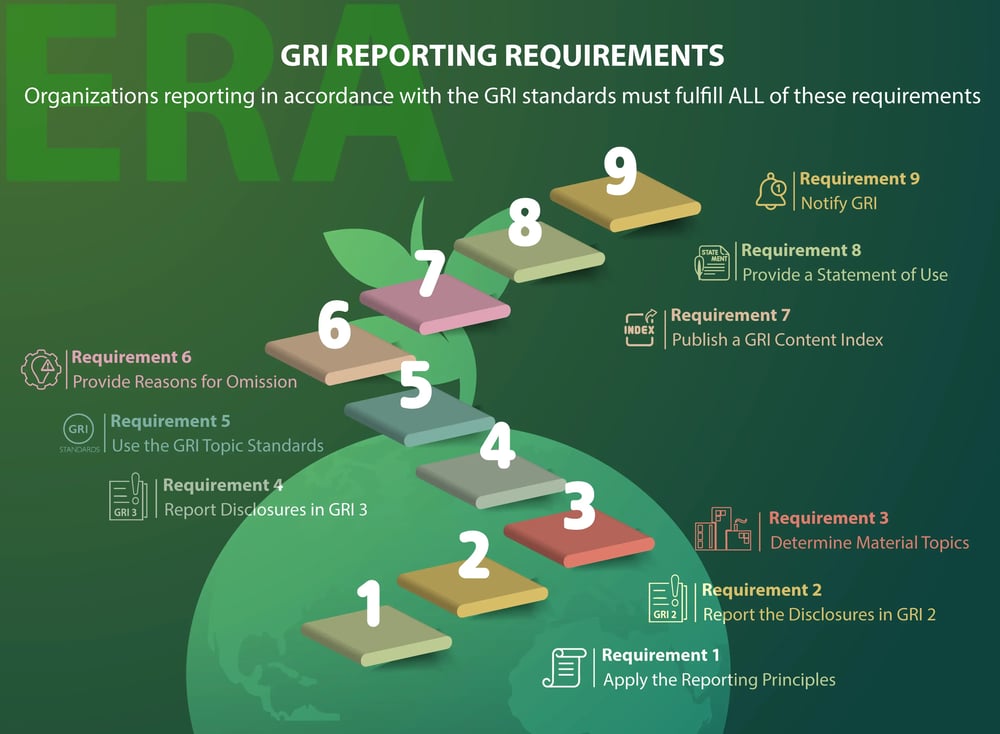
Requirement 1: Apply the Reporting Principles
There are several key reporting principles that must be applied under the GRI framework. That includes four principles for defining report content:
- Stakeholder inclusiveness
- Sustainability context
- Materiality
- Completeness
And six principles focused on report quality:
- Accuracy
- Balance
- Clarity
- Comparability
- Timeliness
- Verifiability
These principles guide the content that should be included in the report and also how it should be presented. They are essential to preparing information that is useful to stakeholders and supporting decisions about the organization’s economic, environmental, and social impacts. The principles also help ensure that the report presents information fairly and in a verifiable manner.
Requirement 2: Report the Disclosures in GRI 2
Organizations must report all disclosures included in GRI 2: General Disclosures. These disclosures provide foundational context about the organization’s structure, governance, policies, stakeholder engagement, and other key elements that support the interpretation of material topics.
There are some cases where an organization cannot report a specific disclosure due to a policy or process not existing. In these cases, it must state the disclosure in question and explain the reason for omissions with sufficient context to maintain transparency.
Requirement 3: Determine Material Topics
Organizations are responsible for determining material topics based on the organization’s most significant impacts covering economy, environment, and people, including human rights impacts. This determination should reflect the organization’s activities, business relationships, and stakeholder engagement practices.
Where available, organizations should refer to applicable sector standards to assess material topics related to their industry. These provide improved consistency with sector-specific guidelines. However, the sector standards are an ongoing project with only four available as of 2025.
- GRI 11: Oil and Gas Sector
- GRI 12: Coal Sector
- GRI 13: Agriculture, Aquaculture, and Fishing Sectors
- GRI 14: Mining Sector
The Global Reporting Initiative has plans to develop as many as 40 sector standards covering different industries.
Requirement 4: Report Disclosures in GRI 3
Organizations must report applicable disclosures from GRI 3: Material Topics for all identified material topics. These disclosures include details such as the process for determining material topics, policies, and actions for addressing them, and how the organization tracks progress.
GRI 3: Material Topics provides a structured approach to explaining the rationale behind topic selection and management strategies. This ensures a consistent and complete presentation of how the organization manages its most significant impacts. Any omissions must be explicitly justified.
Requirement 5: Use the GRI Topic Standards
Each material topic must also be reported using disclosures from any relevant GRI topic standards, which provide in-depth guidance on a diverse range of issues from emissions to supplier social assessments. Organizations select and apply only those topic standards relevant to their material topics.
The topic standards allow organizations to provide detailed, topic-specific information that complements the universal requirements in GRI 2 and 3. Using the correct disclosures from these standards strengthens comparability across organizations and sectors and improves the usefulness of the report for stakeholders.
Requirement 6: Provide Reasons for Omission
If the organization cannot comply with any disclosure or requirement for which omissions are allowed, it must clearly identify the item and provide an explanation. This explanation must be included in the content index and should enable stakeholders to understand the reason and assess its significance.
Some common reasons may include the nonexistence of a policy or the inability to collect required data. However, this requirement does not excuse the organization from the obligation to explain the situation or from considering how it might improve future disclosures.
Requirement 7: Publish a GRI Content Index
A GRI content index must be published and must list every GRI standard and disclosure used, along with the location of the corresponding information. The index helps ensure traceability, allowing readers to quickly verify and navigate reported content.
If the sustainability report is a standalone document and the content index is published separately, a link or reference must be provided. The format of the index must comply with the requirements outlined in GRI 1: Foundation or follow a functionally equivalent structure.
Requirement 8: Provide a Statement of Use
The statement of use must specify that the organization has reported in accordance with the GRI standards, include the name of the organization, and state the reporting period. This statement must appear in the GRI content index and must follow the prescribed format in the standard.
This declaration is a formal acknowledgment of compliance with the GRI reporting requirements. It signals to stakeholders that the report meets a globally recognized level of rigor and transparency in sustainability disclosure.
Requirement 9: Notify GRI
To complete the process, the organization must notify the Global Reporting Initiative that it has used the standards. This notification must include the statement of use, the content index link, and contact details for a person within the organization.
This step enhances transparency and supports the ongoing development of the GRI Standards. It allows GRI to maintain a record of organizations using the framework and supports broader efforts toward harmonized sustainability reporting.
Reporting With Reference to the GRI Standards
Organizations that do not meet all nine in accordance requirements may still report using the GRI standards by following the with reference to approach. This alternative allows for more flexibility while still requiring the use of GRI 1: Foundation and at least one relevant topic standard.
The report must include a GRI content index and a formal statement of use that clearly indicates the organization is reporting with reference to the GRI standards. The content index must cite the specific GRI Standards and disclosures used, along with the location of each item.
This option is often used by organizations just beginning to align with the GRI framework or those reporting on a limited set of topics. While it allows for transparency, it does not offer the same completeness or structured comparability as the in accordance level of reporting.
Making GRI Reporting Easier With the Right Sustainability Software
GRI reporting covers an extensive range of topics, each of which has its own disclosures that require specific data. To ensure complete and accurate reporting, your organization will need extensive data on everything from energy use and emissions to local community impact and supplier social assessments. Just gathering this data is challenging enough, but you also need it in the proper format and units as required by the GRI standards.
ERA’s Corporate Sustainability Software helps your team overcome these challenges with built-in templates, a robust library of standard metrics, and calculations backed by a database of emission and conversion factors. Complete customization for metrics and factors lets you use ERA’s software to ensure data integrity across all material topics relevant to your organization.
Beyond reporting, ERA’s software supports your team in continuous improvement and reaching your sustainability goals. With dashboards tailored to specific roles, you can ensure that everyone at your facility has the visibility needed to evaluate and understand sustainability KPIs relevant to their work. You can make sustainability a fundamental goal at every level of your organization.
Putting GRI Reporting Into Action
GRI reporting is essential for demonstrating transparency, accountability, and a commitment to sustainable practices. With the right understanding and tools, organizations can streamline sustainability and ESG reporting, meet global standards, and generate meaningful insights across a wide range of impact areas.
ERA’s Corporate Sustainability Software helps make that possible. If you’re ready to simplify your sustainability reporting practices and work toward your goals, schedule a discovery call with one of our project analysts to see how ERA’s software can support your operations.
Contributing Scientist of This Article:


Comments